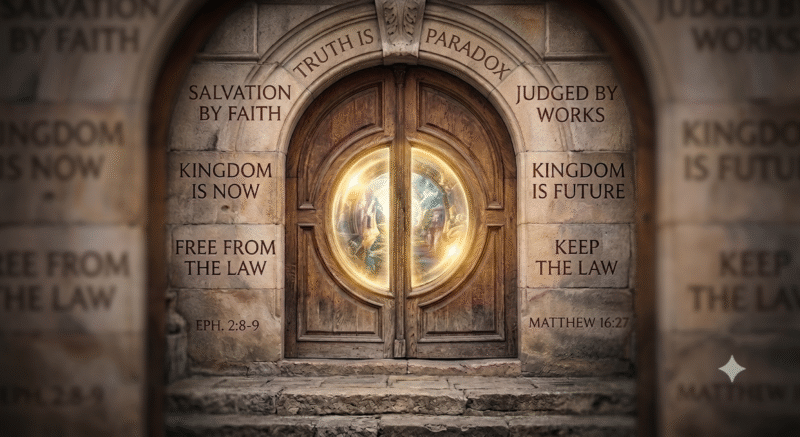
Truth Is Paradox
In 1967, my junior year at Wheaton College, I studied under the esteemed philosopher Dr. Arthur Holmes. You can look him up. One day he made a statement I found astonishing: “Truth is paradox.” On the face of it, this seems to assert that two contradictory things can both be true. But I came to realize that’s not the only meaning. Paradox can also describe something that appears contradictory but isn’t. Further reflection shows it’s not a contradiction at all, but a window into deeper truth.
Biblical Paradoxes
Much theological error comes from grabbing one horn of a dilemma and denying the other. Because of the complexity of God, creation, and divine truth, we find important truths through paradox. Here are a few worth noting. The Bible teaches that we are saved by faith, yet says we will be judged, or saved, by our works (Eph. 2:8-9; Matthew 16:27; II Cor. 5:10; James 2:24). The Bible teaches that the Kingdom has come and that the Kingdom is future — already but not yet. Which is it? John and Yeshua said the Kingdom of God is at hand, which many interpreters read as “available to you” (Matt. 3:2, 4:17). The Bible tells us we are free from the Law, but then says we are to keep the Law (Rom. 7:1-6, Romans 8:4, I John 3:4). The Bible indicates that God knows the future and has predestined us to be conformed to Yeshua, yet says that salvation is offered to all (Romans 8:29, II Peter 3:9). Yeshua tells us in Revelation 22:12 that He is coming soon, but Peter tells us that with God a thousand years is as a day (II Peter 3:8). There are other paradoxes we could point to as well.
Embracing the Paradoxes and Going Deeper into Biblical Truth
The key to solid grounding in the truth is embracing the paradoxes and drawing out interpretations that reveal the deeper truth beneath them. There are even times when the Bible itself provides a path of resolution. Let’s look at the ones I’ve listed.
- Grace and works, or grace and law. God has not eliminated His standards. He calls us to live according to His standards, as in the Law of Moses and the commandments of the New Covenant Scriptures. The truth in the paradox lies in how we approach the Law. On the basis of our own efforts and self-righteousness, we stand condemned. Yet the grace of God is the empowerment of the Spirit by which we obey. Romans 8:4 notes that the requirements of the Torah are fulfilled by those who walk by the Spirit. There is an entirely new grace, power, and Spirit by which we live. Eph. 2:8-9 tells us we are saved by grace through faith, but then says we are to work out our salvation in an obedient life, for God is at work in us. We are created to walk in the good works God prepared beforehand for us. Judaism knows this paradox too, singing in the High Holiday liturgy that we have no works to commend us but depend on His mercy and grace (Avinu Malkeinu). Fail to handle this rightly, and you fall either into hyper-grace theology, where one can continue in sin and still be saved, or into works righteousness.
- The Kingdom has come but not yet. The passages describing the future Kingdom are too numerous to list — that we will rule and reign with Him, that the twelve Apostles will sit on twelve thrones judging the nation of Israel (Matthew 19:28), that Yeshua will attain rule over all the nations after His return (Rev. 21, 22), plus the great statements of the prophets about that future, glorious Kingdom. Yet Yeshua taught that the Kingdom was in our midst (Luke 17:21). It has begun and is growing like yeast in a lump of dough (Matthew 13:33). It is spread by the Word (Matthew 13:1-8), but it also grows alongside weeds (Matt. 13:24-30). With the death, resurrection, ascension, and rule of Yeshua, and the giving of the Spirit, the Kingdom is here now, but only in part. We still look forward to a future Kingdom when all opposing rule is defeated. In this life, as Yeshua said, we will have tribulation (John 16:33). Those who overemphasize the future miss the benefits and power that are theirs now. Those who overemphasize the present — realized eschatology — miss the blessed hope of His return and our ultimate destiny.
- Is Yeshua coming soon? Was He really coming soon, as He announced to His disciples and in Rev. 22:12? From our human perspective, it can seem like this statement wasn’t true. II Peter 3:8 tells us the delay is no delay to God, for with God a thousand years is as a day. This gives us the key to living in the tension: He could come soon, but there could also be delay. We plan for both possibilities. The paradox itself is what shows us how to live between His ascension and His coming.
- Does God know the future, and are we predestined? The Bible does say we are predestined to be conformed to the image of His Son (Romans 8:29). Ephesians 1 tells us we were predestined, or chosen, in Him before the foundation of the world. But as noted, Peter in II Peter 3:9 speaks of the delay in His return as rooted in His desire to give more people time to repent. I Tim 2:4 says God desires all people to come to the knowledge of the truth. For some 58 years I have reflected on what time is like to God, and I know I cannot fully work it out. Strict predestinarian Calvinists land on one side of the paradox, saying God simply chooses some to be saved and some to be damned. Radical free-will advocates argue the opposite — that God cannot know the future in detail, since the choices of free beings are undetermined and unknowable. Isn’t it better to embrace the paradox, and say that God holds all things under His ultimate control while human beings remain free to choose, to respond, to be saved or lost?
The Bible presents us with non-contradictory paradoxes that deepen our spirituality. If we reflect on them, we’re left in awe of His majesty and the unmatched depth of the Word of God.