The occasion of this article is a book I read by an Antiochian Orthodox Christian theologian/pastor, Stephen De Young, The Religion of the Apostles: Apostolic Christianity in the First Century. Dr. De Young wrote another book, St. Paul the Pharisee: Jewish Apostle to All Nations. Both books are quite amazing. The latter sees Paul within Judaism and loyal to the Torah and Jewish traditions. It fits what is today being called the “Paul within Judaism” school of interpretation. The former has some significant insights into the plurality of God in the Hebrew Bible and also puts forth a theology of the Council of God.
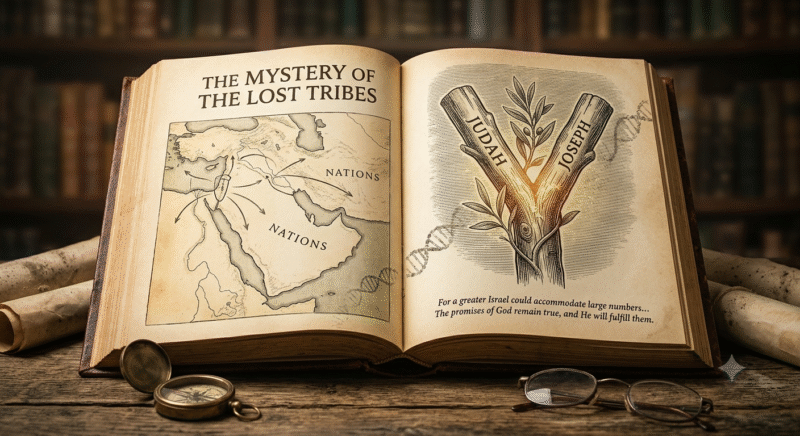
In dealing with the so-called lost ten tribes of Israel, the author asserts that the fulfillment of the promise of their regathering is in the Church. Since the lost tribes were scattered to the nations, their separate identity was lost, and now their DNA is mixed with the DNA of many nations. Their physical DNA has been greatly diminished and their ethnicity also lost. However, through the spread of the Gospel, the nations are gathered, including those with ancestry from the lost tribes. The author is not asserting the Ephraimite movement error claiming that the Church is literally the lost tribes. Rather, those who become Christians are literally their descendants. De Young does not address the prophecies that the scattered northern tribes are promised a regathering to the Land of Israel. He comes very close to replacement theology, or supersessionism. In my evaluation, the mysterious promise of the Bible to restore the northern tribes of Israel remains unsolved. Judah was preserved and brought back to the Land after the Babylonian captivity at the end of the 6th century B.C., as predicted by Jeremiah.
The Thirteen Tribes
The idea of a division into ten tribes and two tribes is simplistic. The south included 3½ tribes—Judah, Benjamin, and Simeon (whose towns were integrated into Judah)—and half of the tribe of Levi. The northern tribes were actually 9½ tribes, since Joseph was divided into two tribes, Ephraim and Manasseh. The Bible promises a restoration to the Land of all the tribes.
The Promise of the New Covenant to Israel and Judah
Jeremiah 31 promises the New Covenant. It is promised to the house of Israel (the northern tribes) and the house of Judah (the southern tribes). The promise continues in verses 35–36 that “Israel’s offspring will not cease from being a nation . . . Only if the heavens above can be measured and the foundations of the earth searched out beneath, will I cast off the offspring of Israel—for all they have done.” This is declared as certain as the fixed order of the sun, moon, and stars (vv. 34–35).
The Prophecy of Ezekiel: The Return of All the Tribes and the Unity of the North and South
Ezekiel 36 promises not only the return of the southern captives from Babylon as prophesied in Jeremiah (the 70 years), but that on the mountains of Israel, God says, “I will settle a large population upon you—the whole house of Israel, all of it.” In Ezekiel 37, the famous dry bones chapter, the bones are the whole house of Israel. God promises in verse 14 to put His Spirit in them, and they will live. The chapter then prophesies the unity of the northern and southern tribes—the two sticks of Joseph representing the North, and Judah the South—and they will become one stick.
Solutions to the Mystery of the Northern Tribes
I do believe that the return of the Jewish people to the Land is a fulfillment of prophecy. But what of the northern tribes? Several solutions have been proposed.
People of the northern tribes came south during the revivals of King Hezekiah and King Josiah and celebrated the Passover. Some stayed and were integrated into the South. Thus, they became one stick. The return to the Land today, then, does include all the tribes of Israel.
There is yet a regathering of the northern tribes to come. We see this also in the return of the B’nei Menashe from India, who have been received in Israel. At the beginning of the Millennial Age, there will be more regatherings. The borders promised for a greater Israel could accommodate large numbers.
The spread of the Gospel does gather those from the northern tribes, and many more from the nations who are not from these tribes. The unity of Christians with Messianic Jews is a beginning fulfillment of the Ezekiel texts, since the Church includes the northern tribes. God will someday distinguish those who are descendants of these tribes and bring them to the Land as their place. This could be a millennial fulfillment. The Church as a whole is grafted into Israel and the Jewish people, as foundational to her identity. A Dutch theologian friend of some note suggested a solution like this. It may be that the DNA is not so diminished as claimed by De Young.
The Mystery Remains
The promises that include the northern tribes still remain a mystery. Perhaps the solution includes all three suggested possibilities. However, my reflection after many years is that I just do not know, and I don’t think we can know. But the promises of God remain true, and He will fulfill them according to their contextual meaning, without spiritualization or replacement theology (supersessionism). I should note that there is also much speculation in Rabbinic Judaism as to how this will be fulfilled—its fulfillment connected to the coming of the Messiah.