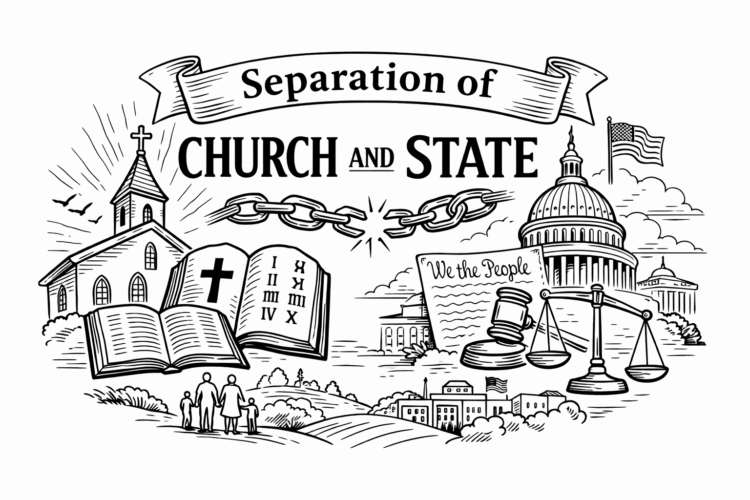
This follows an earlier article. Readers should understand that my position is informed first by the Bible, then by the Reformed Protestant consensus that influenced the early formation of the United States constitutional system, and finally by the history of how this separation was interpreted.
The Bible and the prophets make clear that nations are accountable to God and to basic universal laws of righteousness. Whatever human governments might arrange, the Bible is our ultimate authority on this issue. A recent, insightful book on the formation of the U.S. constitutional system by Jewish and Christian authors illuminates the founders’ thinking (Wilfred M. McClay, Jewish Roots of American Liberty).
Reformed theology developed a correct understanding of separation. It held that three necessary spheres of authority exist: the family, the state (civil society), and the religious sphere (the Church). Each sphere is largely autonomous and accountable to God’s law within its own domain. There is mutual influence and some overlap, but one sphere should not control another. The state, for example, does not preach the Gospel — that is not its sphere.
This understanding aligns with the Declaration of Independence, which affirmed that all human beings are created equal and that rights are God-given, not granted by the state. That assumption underlay the Constitution even if it was not explicitly stated. Therefore, laws had to be measured against Biblical civil law for legitimacy. The battle against slavery manifested this understanding. Many founders repeatedly affirmed that the Republic’s success depended on the morality of the people, and that morality was sustained by religious faith. Morality would falter without that religious foundation. Washington, Adams, Franklin, Adams (again), and even the heterodox Jefferson strongly affirmed this. The state’s function, within its sphere, was to provide order in which religion could flourish — by religion, they assumed the religion of the Bible. The state’s accountability to God was acknowledged in congressional prayers, prayers at national celebrations, and acknowledgments by political leaders until recent times.
The laws for the state derived mostly — though not exclusively — from the Hebrew Bible. Part of that understanding is that the state would make no laws undermining the foundation and prosperity of marriage and family, since family stability was essential to the functioning of the state. Today, the breakdown of the family correlates with the breakdown of law and order. The state should make no law impeding the religious sphere. The religious sphere has a teaching and prophetic function to call the state to obedience to God in its domain. Laws promoting gender fluidity, transgenderism, or same-sex marriage, in this view, undercut reverence for marriage and family. Without the Law of God, civilization becomes like a cut flower — there is no measure to determine unrighteous law. The Bible warns against such unrighteous laws.
We speak of the Laws of God for the state as universals, not the time-limited statutes. This begins by recognizing that all human beings are created in the image of God and deserve equality before the law. It includes those commandments from the Ten Commandments that apply to the civil sphere: no stealing, no bearing false witness, not murdering, and honoring God (for example, oaths in courts). It includes just weights and measures (honesty in business), honest judges and courts where two or three witnesses are necessary in capital convictions, and the rejection of trial by ordeal. It sets up sufficient lower courts for accessible justice with appeals to higher courts. It enjoins severe penalties for murder, rape, and kidnapping. We take these standards for granted but many societies did not practice them. In the Bible, might does not make right; the ruler is accountable to God’s law, not above it. There is also a separation of powers and checks and balances in a decentralized system. The United States even applied the Sabbatical-year law for debt relief in bankruptcy filings, though only every seven years.
I believe the state is duty-bound to acknowledge accountability to God and his law. Hence we read “In God We Trust” and “one nation under God.” How should the state treat those who do not believe in God or his law? As citizens created in God’s image, they are due equal rights and dignity. They may opt out of the state’s confession of God, but they must recognize the majority will when the polity acknowledges the state’s accountability to God. The system we promote is possible only when the majority of citizens embrace it; the founders understood this. I again call for a more accurate historical understanding of the separation of church and state and of the Jewish-Biblical foundation of society.