Why Do Conservatives watch Fox News and Alternative Conservative News Stations

For my American Friends, a departure from my usual topics

Though it is hard to believe, there are some Jesus/believers who outright trash Fox News and alternative conservative media. Can it be only because they do not watch it much?  I remember when CNN and majority media stations did panels reflecting different viewpoints.  Conservatives and liberals both presented.  However, I watched as majority media became more and more partisan and fewer and fewer conservatives were heard.  I became very alarmed at the imbalance.  Then Fox was born with its motto, “fair and balanced,” and restored the panels with both sides. I was very glad. However, over the years as majority media became more and more partisan Fox also became more partisan though its commentary had always slanted right. However, Fox still maintains more balance and more shows presenting Democrats and liberals.  When my anti-Fox friends speak about Fox, I believe it is due to what they hear on majority media and the echo chamber in their social media choices.  When they think of Fox, they think of Sean Hannity who is strident and often not balanced.  Though I like Tucker and Laura Ingraham, when I think of Fox I think of Bret Baier.  His, in my view, is the most objective news program and has those panels. But more I think of great conservative thinkers drawn from the conservative think tanks like Heritage, American Enterprise, Hoover, and Manhattan, think tanks and organs like the Federalist and the American Spectator.  I think of folks like Kimberley Strassel of the Wall Street journal whose books are important.  I think of Robert Woodson, the great black leader who was the partner to Martin Luther King, Victor David Hanson of Hoover, Larry Elder, the great black thinker, and radio host.  They reflect the views of the great Dr. Thomas Sowell. Then I think of moderates who have been closed out of majority media like Alan Dershowitz, and Bari Weiss and Alex Berenson, both formerly of the New York Times, the amazing Cheryl Atkinson, Laura Logan, and John Solomon, investigative reporter formerly of the Washington Post who now runs Just the News.  

Then there is social conservativism.  Are supporters of traditional standards on abortion and marriage and family standards given a place on majority media?  The danger of the LGBTQ agenda?  Are any allowed to present this on the majority media?  Even on biological men in women’s sports, bathrooms, and locker rooms?  No, only on conservative alternatives.  Or the danger of critical race theory in our schools?  No.  

This is quite a list, and the people I mentioned have no voice without conservative news sites.  I am sorry but I still think majority media is way too partisan and even more than Fox.  However, it is not that I am in full accord with the thrust.  I think what these folks miss when they claim that the danger today is socialism on the left, they do not see that the much greater danger is of a fascism that is part socialist and the thought control that is coming from the concentration of power in a few who have too much money and power.  Capitalism has to be much more regulated re: such concentrations of wealth and power is dangerous, and I wish people would see that.  Both liberals and conservatives do not nearly address this. 

CANCEL CULTURE, Will the Bible Be Canceled?

David Weinberg, the Vice President of the Jerusalem Institute for Strategy and Security, writes some very good columns most weeks in the Jerusalem Post.  This week’s column entitled Is Banning the Bible Next? The Terror of “woke” Cancel Culture that Knows no Bounds, is an excellent column.  In it, Weinberg notes the power of the easily offended, who are also forming a contingent of cultural warriors out to destroy all that that does not fit with their sensibilities.  He notes the new western fear society, the cancelation or the attempt to cancel Babar the Elephant, Curious George, Peter Pan, Dumbo, Dr. Seuss (at least in part), Swiss Family Robinson, Mr. Potato Head, the Muppets, Sesame Street (with warnings), and of course, Tom Sawyer, Huckleberry Finn and of course, Gone with the Wind.  Sometimes we are amazed that there is a group of people who spend their lives combing cultural and literary works to seek to have them canceled.  Who are the people engaging in this?  We would like to name the leaders.   We would like to see them canceled and know-how can they possibly have such influence.  So much of what they seek to cancel hardly offensive.  One has to really be stretching to find some of these things offensive. 

My high school years were from 1962-1965.  There was already a strong and good attempt to counter bias through the teaching of a contingent of very good teachers.  I wonder how such teachers would compare with today’s teachers.  Whether reading Mark Twain or Shakespeare (Merchant of Venice and its stereotype of Jews), our teachers were able to explain the great literature as well as to show the cultural limits of the writers.  In Twain’s case, we were able to note his anti-racist life positions and not misunderstand his portrayal of blacks and poor whites in his novels.  Culture changes and how a culture perceives people and issues will vary.  If the people of each new cultural trend then cancels and tries to eliminate books, literature, and more of the past, the cultural treasures that inform us, though interpreted and evaluated by where we are in history, will be lost.  It is almost as if the radical cancel culture folks want to eradicate history and literature and start with a blank slate and begin writing from their own present biased orientations.  This is very sick and yet they get away with it. 

We have to evaluate historical figures on the basis of their time and ask what progress they made toward a more enlightened way of thought and endeavor.  The Bible gives us the norming norm for this evaluation, and nothing less will do as the norm.  Ethical norms without a Biblical orientation will break down.  The equal worth of every human being will break down into a tyranny of equality of results in income or equal outcomes that will lead to central control and tyranny. 

Then there is Weinberg’s question about the Bible.  The Bible is really offensive unlike some of the literature that the woke culture warriors seek to cancel. What he misses is that the attempt to cancel the Bible is already gaining ground in some countries.  Reading Romans 1 with its moral pronouncements is considered hate and forbidden.  There is much to be offended at in the Bible.  That one people would be elect and distinct from other ethnicities is very offensive to today’s woke contingent.  How about the idea that if one does not accept Yeshua one can die in sin and go to Hell?  How offensive is that?  How offensive that there is one true religion?  The Bible also justifies eliminating the tribes of Canaan.  The Psalmists prays for the crushing of the enemies of Israel including destroying the children of the conquerors.    

In Seminary we learned about progressive revelation.  Not all that the Psalmists pray is the heart of God for us to pray.  We are now guided by the Sermon on the mount and the love of our enemies.  We are not commanded to eliminate any people but to love them, pray and work for their salvation.  What God permitted in the progress of history in the pre-New Covenant period now has to be applied under the standards of the New Covenant and the pictures in the prophets that foreshadowed the broadness of God’s heart for all people.  

However, cancel culture people will not be patient or tolerate such explanations.  In addition, there is no way out of the narrow way that leads to salvation; that Biblical faith is the true way of salvation and superior and unlike all other religions.  Its rigid moral standards for sexuality and monogamous marriage will certainly be considered hate speech.  Weinberg anticipates the attempt to cancel the Bible.  It will certainly happen.  The new tyrants in social media will see to this. However, what will we do?  We cannot stand up to this with a milk toast kind of faith.  No, it will require us to enter into a place of God’s presence and power that is far greater than in Western Christianity.  It will require levels of revival and revival living that we can hardly imagine.  We can receive such love and power and must!

Party Politics and a Biblical World View

The recent elections in America raise some difficult issues for followers of Yeshua.  I would like to go deeper into a larger question.  That question is whether or not we can be “all in” with a political party.  As an observer of politics since the Nixon-Kennedy election, I have watched the change among white Evangelicals from the majority being Democrats or at least voting for Democrats to being Republican voters.  How did that happen?  Evangelicals were quite favorable to Roosevelt.  My Evangelical relatives spoke of Roosevelt with reverence, and that includes my mother. (I am Jewish through my father).  They saw the Democrats as the party supporting policies that would advance ordinary people, modest people like most Evangelicals were at that time.  They also felt a responsibility for the poor. Many were immigrants’ children and had the experience of hard knocks.  My own view is that the big change came due to social issues.  The right tax rates, money supplies, banking policies, and other matters of economic policy were too abstract for so many.  There was more trust for national leaders.   When the Democrats supported abortion, easier divorce, and then became pro-gay or LGBTQ as it is known today, there was a great Evangelical shift.  This is understandable.  The Black community and many Hispanics (they are more divided than Blacks) saw government support for lifting their community as more important than abortion, gays choosing to marry, or easier divorce since one could choose not to have a divorce or to live a gay life.  The issues of being supported to overcome poverty was considered a greater issue than the others.  So Black Evangelicals stayed mostly Democrat.  

I am very much on the side of the Republicans on the social issues, but my views on many other issues are more nuanced.  We have to look at things from a biblical worldview perspective.  There are first the issues of principle and then the empirical issues of what works.  Here are some Biblical norms that few talk about but should.

  1. The Gospel is primarily spoken to and for the poor, the oppressed, and the captives.  (Luke 4) This is in line with the prophets who deal with two primary sin areas that bring the judgment of God.  The first is idolatry. The second is the treatment of the poor, the needy, the widow, the orphan etc.   
  2. A study of the Bible brings out the fact that human beings are fallen, prone to evil and greed.  Therefore, the Bible is oriented against the great concentration of wealth and power in the few or a controlling oligarchy.  Such concentrations will not turn out well.
  3. The Bible enjoins a broad distribution of wealth while allowing growth in prosperity by diligence.  However, because wealth is primarily in land, that is re-distributed and returned to ancestral families every 50 years.  That is the great equal opportunity idea of the Bible, the Year of Jubilee.  Note the prophets railing at those who had added field to field and built large houses on large estates and did not obey the jubilee law.
  4. The Bible requires leaving gleanings, the corner of the field, and a partial tithe for support for the poor. 
  5. Loan sharking is absolutely forbidden.
  6. The Bible enjoins a strict sexual morality and family order. 
  7. All of this is based in the fact that every human being is created in the image of God and to be treated with respect and dignity.  The courts of law and justice must show this truth.  

These are the principles.  Then there is the empirical reality.  The development of economies in the world are so very different than the older agrarian economies.  We now have wealth connected to huge corporations and industrial enterprises, many multi-national.  Modern governments in developed societies have produced huge bureaucracies.  The question for society is what is the best system of economic organization for lifting the greatest number of people, providing adequate income for gainful work that treats employees with dignity.  In a modern society, we also deal with health care and its availability and delivery.  The problem with socialism is that it leads to greater poverty and does not produce the creativity and drive to increase the wealth of the society.  The problem with capitalism as it has developed is that it has produced huge disparities of wealth distribution where there is too much power in a few and many are exploited.  They then control the government through lobbies and contributions.  Unions have been helpful, but some unions are now part of the problem.  Some unions have negotiated packages that are bankrupting cities with six-figure pensions.  This is unfair to people with no unions or weaker unions.  I think teachers’ unions are now destructive and have produced a destructive monopoly.  An education for decent vocations is a crucial issue and hence competition is crucial. 

Can free enterprise be designed that limits obscene wealth and power concentrations while allowing the motivation of reward for enterprise?  Can this success be of greater benefit to the many?  Can we see profit-sharing, stock for employees, and more for employees?  Also, how shall we deal with robotics?  What if there are just not enough jobs; will there be a robotic dividend for people.  The idea of greater leisure due to robots was the talk of futurists decades ago.  They speculated on a much shorter work week. I think Andrew Yang who runs for mayor of New York is thinking about these things.  Higher minimum wages may lead to job losses and robot replacements.  Do Evangelicals wrestle with these issues?

Then finally we think of reforms in-laws and penalties for crime.  Can we think more deeply about the fact that the Bible has no prisons for non-capital crimes, but requires restitution with penalties?  It is justice but restorative justice.  How should that orient us to reform in the justice system? 

I often think that because people do not credit the Torah and the authority of the Hebrew Bible, they miss the important teaching of the Bible and its principles for societies.  These are reasons why I cannot really be totally at home with political parties.  These parties are coalitions of interest groups.  Many of the positions of political parties are for the sake of gaining the support of those interest groups and for the sake of keeping politicians in power.  But the policies on issues in these parties do not cohere with each other.  Have you ever thought about how arbitrary it seems that a party’s policies on different issues do not form any coherent whole?  Only the Bible can give a coherent whole on issues and then pursue the truth empirically as to what works best in implementing the principles. I try to wrestle with some of this in my book “Social Justice.”

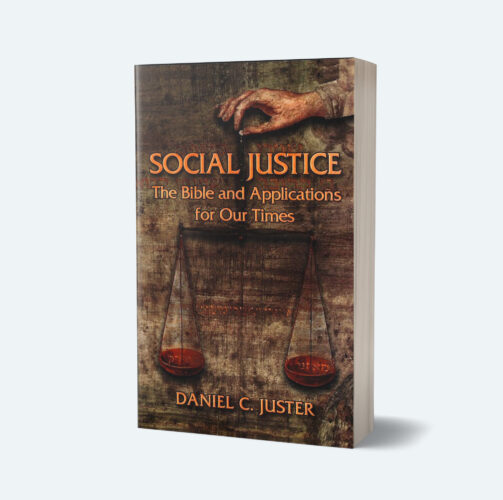
Social Justice

I wrote the book Social Justice to address the meaning of social justice from a Biblical Worldview perspective.  The book both deals with the general teaching of the Bible, beginning with the Torah and then the rest of the Bible on the issue of social justice, and then goes on from there to address specific hot issues today.  

Hundreds of years before Yeshua, Plato wrote the dialogue Euthyphro.  The dialogue is usually considered to actually reflect the approach of Socrates.  Socrates questions a young man who is going off to war.  He asks why he is going.  He responds that he is going to fight for justice.  Socrates questions him about the nature of justice.  Euthyphro finds that every definition and defense he gives for fighting is undermined through the incisive questioning of Socrates.  He simply did not know what justice was.  He decided to go home instead of going to war.  I think that we will find that many social justice warriors would end with the same confusion as Euthyphro if they were carefully questioned. 

How many in our own day are social justice warriors but have no definitions or framework to engage the justice issues of our day?  My book provides the definitions and framework, both by giving a biblical description of what constitutes a just society and secondly by defining love, the motivation for seeking justice.  Woe to us if our directions are not based on the Bible. 

The reader may be surprised that not all that is generally pushed by conservatives is in accord with biblical norms of justice.  The same goes for liberal solutions.  Those who have endorsed this book found it to be an absorbing read and accurate to the Bible.  This includes the famous former President of Gordon Conwell Seminary, Dr. Walter Kaiser, and Dr. Jerry Dirman, one of the key national leaders in the United States in the Foursquare Church of God.  

The reader will find that rightly preached, the Gospel of the Kingdom is the greatest possible social justice message with the power to change people and society.  Establishing discipling communities that live out love and justice is God’s key foundation for the pursuit of love and justice.  

This book was especially written for young adults, parents, and pastors who are finding a rift over the issues of social justice.  It can help bring us back together into unity. Do sign up for our newsletter as well when you order this book. 

Revival: Is There Anything We Can Do?

Those who are following the American situation in regard to Christianity, politics, the Trump administration, and the election of Joe Biden recognize the upheaval, controversy, the prophetic questions and disappointments and so much more.  I have addressed some of this in the past and always noted that progress for righteousness in the society and through politics can only be lasting in a context of a revived and growing Body of Believers in a nation that is producing quality discipling communities that change the culture of the nation.  Revival is the center of my hope whether or not we enter into a period of respite and restoration in the United States or whether the revival prepares us for the soon-coming great tribulation. 

I have argued theologically, along with a stream of Bible interpreters, from Puritans, Lutheran Pietists, to the revivalists in the 17th to 20th centuries, that there will be massive world revival that will enable the completion of world evangelism on this side of the Millennium.  That revival will be in Israel as well and a key to Israel’s salvation.  Acts 2, in this view, was a great installment of Joel 2, but the ultimate fulfillment is just before the return of the Lord and includes the final signs described there.  I have a good historical consensus and scholarly support for this view.  However, there have been revivals in the interim.  

In 1968, J. Edwin Orr, of Fuller Theological Seminary, the historian of revival spoke at Wheaton College.  He presented the case that great progress for the Gospel was an outworking of outpourings of the Spirit.  His writings give great detail on this.  Richard Lovelace of Gordon Conwell Theological Seminary, in his Dynamics of Spiritual Renewal argued similarly.  

In my own limited experience, I saw how an outpouring at Wheaton college in my wife’s junior year transformed the campus in 1969 and again in the 1990s.  Beth Messiah, my congregation, touched and influenced by the revivals and renewals in Pensacola, Florida, and Toronto, Canada.  We had many visiting leaders connected to the outpourings of those days.  The effect was that a large contingent gave themselves radically to Gospel ministry.  We sent dozens into full-time ministry.  It was amazing. 

But again, is there anything we can do to foster revival, an outpouring even if it is not the final and great one for which we pray and hope?  Charles Finney, the great evangelist of the mid 19th century, argued in his Lectures on Revival, that if the conditions are met, there will be revival. Lovelace, a more Calvinist historian, did argue that concerts of prayer were keys to revival but the sovereignty of God was much more in view, and people cannot make a revival happen.  O. K., but can we make it more likely. 

Here are my gleanings from my studies on revival and from my experiences.  

  1. Revival is much more likely when a people are prepared to long for revival.  How does this happen?  By preaching that centers on revival, first the biblical texts and then the stories of revivals and what happened and can happen again.  Fostering this longing in a growing group of prayer partners and in congregations often precedes the revival. 
  2. Revival preachers are keys to revival.  They are able to call people to repentance and dedication.  This does happen as a product of revival, but there is also a pre-revival preparation. I think that having revival and ministers that moved in the power of the Spirit was a key to what was produced in the 1990s in our midst.  We encouraged people to visit where such outpourings were taking place and also sought to bring it to our community.  We would not make our desire for Jewish indigeneity and identity be a barrier to this.  We also embraced manifestations that some would question as really normal historically.  We did not shut down what made us uncomfortable.  We prepared out people for this.  (See psychiatrist John White, When the Spirit Falls in Power. 
  3. Then, we have to know and prepare for revival so the fruits of revival will not be lost. I think many think they would like to see a revival but are not aware that the revival will upend their lives if they submit to what God wants to do during such times.  Evenings will be taken up in power evangelism with signs and wonders and gatherings in meetings together.  Some people will be so touched by the Lord that they will spend hours in his presence, sometimes on the floor and not able to move.  Signs and wonders will be part of the meetings. We see this in the ministries of Jonathan Edwards, Ludwig Von Zinzendorf and the Moravians, the John Wesley and the Methodist revivals, Peter Cartwright, Evan Roberts and the Welsh revival, Azuza Street and the Pentecostal revival and movement, the Latter Rain movement from Canada, and so on.  Randy Clark in his book, There is More, gives a good summary. The parallels in all these revivals are quite amazing. 
  4. I think God is more likely to send such a revival when there is preparation for stewarding it.  This includes the fact that we will have to teach large groups of new believers.  Teaching them the Bible and how to walk as believers can take place in larger meetings, but will also be in small groups like the Methodist Bands.  This was the Acts 2:42 model. Maybe God does not send the revival because He knows that people will not pay the price that receiving the Glory will entail. 

Yes, the greatest revivals did produce social transformation. More than that, however, they ended making great gains for the spread of the Gospel and the multiplication of congregations. 


The Concentration of Wealth and Power

Not long ago, President Barack Obama stated that, “At a certain point you’ve made enough money.”  There were howls of protest.  The more libertarian of Republicans pushed back hard and asserted that however much money a person can make within the laws of the land was perfectly in order and no one should think otherwise.  Many believers being Republicans got on the bandwagon against his words.  It was socialism! A few years before that the Supreme Court in the Citizens United case threw out by 5 to 4 the limits on contributions by corporations and unions to organizations involved in political activity.  The campaign finance law had the backing of some Republicans and Democrats. On the Republican side, Senator John McCain was the most known. Again, some of the conservative Republicans embraced the court decisions since as the court said, such limitations of contributions limited speech.  Those supporting the law said that, on the contrary, such big money drowned out the speech of the rank and file voters.  

For a time this seemed to favor Republicans but the last election showed big money by far more greatly given to Democrats. 

Then forward to the campaign of 2020.  Elizabeth Warren argued that the level of wealth held by a few distorted the economy and politics of the nation.  For a long time, she held out against contributions from the corporations of the rich.  Then Bernie Sanders railed against the billionaires.  Most Republicans pushed back hard.  Warren talked of a wealth tax to be assessed on the net worth of the individual.  How would it be assessed?  After all, wealth fluctuates as values go up and down over the course of a year.  Yet strangely the superrich mostly supported the Democrats in the election.  For decades conservatives argued that the wealthy becoming more wealthy is no problem since they have to invest their wealth and that creates economic expansion for everyone.  But there are other issues. 

I personally believe that the issue is wrongly framed between socialism and free enterprise.  Rather I think what is really happening is that the superrich project themselves as being for greater socialism to keep the leftist populists at bay while they work to control more and more wealth and power and take the nations where they desire.  What is really desired by them is a technocracy where the wealthiest oligarchs control the direction of societies.  To do this, they have to control media, communication of all kinds (including social media) and control the elected bodies through enormous campaign spending and buying politicians.  It is crony capitalism at the highest level while projecting a socialist agenda to keep others at bay.  It is a level of control that is unprecedented. Corporations now have more income than good size nations and have more power.

Recently a news organization reported on Bill Gates of Microsoft and Big Pharma fame, becoming the largest landowner in the United States. Why would he be buying all that land?  It then was reported that Gates is calling for an end to eating meat.  He is for synthetic meat and vegetarianism.  He is so super-rich that he can afford to buy huge tracts of land at higher than going prices and then take them out of meat production.  There will then be less land for cattle and the price of meat will soar.  Only the very rich will be able to afford it.   His wealth can change the direction and eating habits of the whole nation.  A case can be made for vegetarianism and the greater prosperity of the world, but do we want to see it come from such control versus communicating through education and debate.  That process is too slow for Bill Gates.  As Lord Acton of England famously said, “Power tends to corrupt and absolute power corrupts absolutely.”  The world may be moving toward world government control by super-rich oligarchs, and democratic checks and balances will only be a facade.  There are some very good books on this.  

As we look at what is developing, are we so sure that the push back against Warren and McCain was really right?  Does the Bible speak to these issues?  And is the concern about the superrich and their political and cultural power only a concern for Democrats or is there a biblical response? 

In the 1970s John Howard Yoder, the famous Mennonite New Testament scholar wrote a book entitled The Politics of Jesus.  The book amazingly had material that supported Messianic Jewish theology. I used it in my book Jewish Roots.  Yoder argues that the year of jubilee principle is a key to understanding Yeshua and the Bible.  Since wealth in agrarian societies was concentrated inland, the redistribution of land to the families of the original ownership clans precluded the concentration of the wealth of Israel in a few.  The prophets spoke strongly against its violation.  Today wealth is concentrated in capital and corporations.  Can there be a free enterprise that brings expanded prosperity for the many and precludes the over-concentration of wealth in a few?  There can be and in some ways, this had happened at times in history.  However, should there be a limit to the vast wealth and power of a few and the ability they have to dominate and control?  Should there be new businesses so money is more decentralized and should stock in large corporations be such that they cannot be controlled by a few?  Should there be limits on political the power of a few so that the many have greater speech and power?  There should be a conversation among Bible believers and serious study on the implications of the jubilee.  Think of it.  A billion dollars is one thousand million.  Can you imagine having to your own account 1000 million dollars?  Then think of this ten times over, ten billion dollars equal 10,000 million dollars!  We now have individuals who have to their own account over 150 billion dollars. Is that a bit frightening?  At a certain point, you do have enough money.   This is an enormous centralization of power and wealth, and I for one think free enterprise needs reform.  Those who believe in the Bible know that when we promote the Gospel and traditional morality and experience we face the push back that it is hate speech.  When we want to educate our children, these super-rich oppose us and want to drive us all in a particular direction of education that is not based on a biblical.  When we see what has happened with social media and the elite controls, I wonder if there could be common ground between some Democrats and populist Republicans on these dangers.  Let’s seriously study the year of jubilee as foundational.  Again, I do touch on this in my book Social Justice. 

Due Process

I participated in a recent phone call of apostolic leaders.   The discussion concerned accountability for prophets and all other five-fold ministry leaders.   This was in the context of what seemed some serious prophetic failures.  The discussion turned to the issue of what is the structure of eldership accountability for such prophets, accountability to a five-fold level of senior leaders who share the responsibility with the prophet.  We certainly hope that prophets who miss it on a serious large level will repent and seek God with their accountability authority to find out what went wrong and be re-positioned for greater quality and accuracy. 

As were discussing this, Mike Bickle, the leader of the International House of Prayer recommended my book Due Process, a Plea for Biblical Justice among God’s People.  Then John Kelly who leads the International Coalition of Apostolic Leaders said it was a very important book.  Sadly, there is not another like it, and there should be.  A publisher on the call said that he wanted to have it re-printed and re-presented.  Why is this book so important?  It is because it deals with a crucially missing ingredient in many congregations and streams.  That is how to maintain basic standards of righteousness in a community.  That requires that we form discipling communities that are able to bring correction to those who err.  It also requires fairness to both those who are corrected and those who bring the correction.  Some of the key passages on these matters are not often taught or even rightly understood. 

The book deals with the important biblical passages that speak about this.  It also presents the role of the elders as first shepherds in love, but also for the sake of the flock as a judicial team that is charged to establish standards and to act when necessary to see that those who will not repent of serious sin are not able to continue in the community, and also that wolves in sheep’s clothing are not given opportunity to devour the sheep.  The importance of Matthew 18 and the process of bringing correction is fully dealt with as well as the way of restoration for those who do repent.  It also shows the way of settling disputes among brothers and sisters.  

We are charged with building lasting covenant discipleship community.  Without the standards of the Bible for Due Process, our attempts could fail.   I hope you all do get his book.  

What are they Teaching our Youth?

My daughter Rebecca is very smart.  Recently she alerted me to what schools are teaching as American history.  The text by Howard Zinn is alarming.  I read the book and sent her this review.  She gave me permission to post this. 

I read the Howard Zinn, A Peoples History of the United States, a book for young people/students and am reading the other lengthy one  I wanted to read the youth one first because the text for young people is more important in influence and in shaping young minds. 

It was very disturbing.  It is not that much of what he says is untrue. Much is true.  And you would be surprised how much of this we learned in U. S. history in our Junior year of High School in1963, 1964.  The terrible issues of slavery were clear as the terrible treatment of native Americans.

One could say Zinn could be titled “A Radical Leftist Interpretation of the History of the United States.”

So what is the problem of Zinn?  It is mostly what he does not say and what he leaves out.

1.  First, World history shows that the issue of the powerful and wealthy dominating and oppressing the rest of the population is universal. This is so in India, China and Africa.  This is not a uniquely American problem. He soft- peddles the oppression and genocide in Africa among tribes.  In addition, he soft pedals human sacrifice in Africa and Central American cultures.  Stunning!  In China and India wars (I read extensive history) the genocide of other tribes was common. The lack of a World history context is a terrible disservice.

2.  He does not understand the basic issue of Western History for 1900 years.  What is it?   It has been the struggle between three groups.  1. Those true to the Gospel and Biblical values who stand for the poor and oppressed and serve them.  2. Those who co-op Christianity and make it a state religion or make it a cultural religion cut off from the commandments Yeshua. The loss of focus on the oppressed and poor as the center of Gospel outreach has been very sad. 3. Those who are not in any way Christians but seek to dominate, and oppress for their own ends.

3. In following #2 he leaves out the history of those Christians who were valiant and key to fighting the oppression.   He names John Newton the former slave trader who was anti-slavery and does not note that he wrote Amazing Grace. His conversion made him an anti-slavery fighter who encouraged the deeply Christian William Wilberforce who was the leader in seeing slavery eliminated in the British Empire. He leaves out the revivalists like Jonathan Edwards’ son in law David Brainard who gave himself to the native Americans and was a champion for the native Americans.  He leaves out the real power of the Christian underground railroad.  The revivalist Charles Fiinney and the founder of Wheaton, Jonathan Blanchard were examples.  Without the revivals the force of the anti-slavery movement never would have succeeded. Who wrote Uncle Tom’s Cabin?  Harriet Beecher Stowe, from the Beecher family. Her father and brother were famous anti slave evangelicals.  He only sees leftist redials as standing for human rights.  But the leader for women’s rights was an evangelical, Susan B. Antony, and she was anti-abortion.  Who led the child labor reforms? Evangelicals.  He leaves out Quaker William Penn who was anti-slavery and pro native American  Also though Roger Williams is mentioned, little is said, but his importance is enormous.  He founded Rhode Island whose law was a key to the religious liberty clause of the Constitution a century plus later. Rhode Island was the first free state in the World on these matters.  Tom Holland, the British Atheist historian says that all our human rights ideas among secularists would not exist but for Christian Bible roots. No culture in history has stood for the equal value of human beings without biblical roots. So also I note the great sociologiest Rodney Stark and his writings on Christianity and its influence.  He also leave sout the Catholic monastics that served the needy, native Americans, blacks and more.  The Catholic workers movement with Dorathy Day was important. Left out!

4. Because of this lack he downplays the importance of the Declaration of Independence, “That all men are created equal and endowed by their Creator with certain inalienable rights, life, liberty and the pursuit of happiness.” Without biblical roots, this would never have been written.  Yes, holding slaves as Jefferson did, was inconsistent to it, and Jefferson really knew it was. But in the economy of those days slavery seemed necessary to Southern economics. Wrong and sad!  But when Jefferson penned this, he set in motion the influence to eliminate slavery and foster the greatest influence for liberation that the world had ever seen on the political level.  The founders that were anti-slavery are not quoted. What they said and wrote was ignored. Read the great John Adam’s biography by David McCullough.  Not even referenced.

The U S was designed to be a Republic with the vote as only one part of checking power. The whole issue was to prevent the centralization of power since human beings can not be trusted with too much power.  Yes, the vote was to be for the educated who were land owners in those days. However, many hoped that others would attain prosperity under the new constitution.  It is wrong to see them all as only in it for themselves, but there was hope for a growing prosperity for ordinary people as well.  And yes, for many it was about self-interest.  But not for the many Christians that were supportive of the new system.

5. It is true that Lincoln was at first more about seeing the country not break into and not for freeing the slaves.  But was it only for special interests of the North only.  Did Lincoln not have higher motives eventually. Lincoln seems to have had a kind of conversion to Christianity during the war.  His words on the judgement of God on all of America and the Civil war as exacting that judgement on both north and south due to slavery are not even mentioned.  Yes, he doubted that the “Negros” could fully integrate, and thought of them going back to Africa to be in their own culture, but that was a culture judgment and wrong. Many fought against slavery with deep conviction.  The Secretary of State Seward was total anti-Slavery and ran against Lincoln for the nomination in 1860.  Slaves from the underground railway were given refuge at his home in Auburn, New York. Carl Sandburg’s biography of Lincoln and Professor Ronald Rietveld of Wheaton were important (your Mom’s professor and an expert on Lincoln). Even Lincoln is being caceled by some today.

6.  For Zinn there are two groups of people in the U. S.  The oppressed and the oppressors. But it is not so. It is also the story of millions of immigrants like my Norwegian and Jewish ancestors who came poor and moved up.  The story of upward mobility in the U. S. is left out. The U. S. does not only have inherited wealth, but wealth has changed hands.  Today it is worse than in recent years due to the accumulation to obscene levels with the likes of Jeff Bezos, Mark Zukerberg and Bil Gatesrg and Bill Gates.  But note how many who came poor did well, as our family, both the Jewish and Norwegian sides.  My Jewish ancestors began in the ghetto. The blacks until recently did not share in this upward mobility, but there is now more upward mobility for them.  But Norwegians, Jews, Poles, and Italians have became decently prosperous. The composition of the town I grew up in was made up of such folks, not very rich, but middle class and living well.  There seems no prosperous middle class in Zinn.

7.  He seems to grudgingly admit that people were oppressed under communism. But his sympathy is for the American communists. The fact that communism leads to poverty and terrible death and oppression is just not there a theme his writing  Yes, the U. S. fought wars for the self-interest of the establishment and its wealth but there were mixed motives and other reasons as well.  To prevent communism and its terrible record of death and destruction is noble. Yes, capitalism has to be reformed and is a long story. But capitalism produces the entrepreneurship that expands the economic pie like nothing else in history and has lifted more out of poverty than any other system.  The wealth expansion has the potential to lift peoples like no other system.  Crony capitalism is its worst negative that has to be faced and has to be prevented. But when rightly directed, it lifts people out of poverty in large numbers. Zinn seems totally unaware.  It is why India and Israel changed to free enterprise; so also now much of Africa. Even China is now fascist capitalism

8.  He does not credit the great gains in the ideas of freedom and liberty that came to the world from America.

9. When he speaks of the spies Julius and Ethel Rosenburg, the Russian communist spies and traitors who were executed, he leave out the fact that when communism fell the records were made known and their guilt was absolutely confirmed.  Others may not have been wrongly convicted for treason over the years, and there were sometimes sad miscarriages of justice. 

10  He idealizes Native American and Black Africans and does not credit other writers.  He selectively picks some writers to idealize those cultures with free love, equal life for men and women etc.

11. He talks about the Israel occupation of the Palestinian land and does not note that for the Arabs, all Israel, including Tel Aviv, is occupied territory. They walked away form a two-state solution twice.

12. Yes though labor unions are now corrupt, the labor movement was a just movement for fair wages, working conditions and more.  However, today those gains are being lost to China.  Why is that?  An interesting story of greed and corruption driven by the elite today.

His view is that redemption will come from the left, but if you study the results of the left in history you will see that redemption only comes from the Biblical faith.

So that is my evaluation.

Christian Nationalism

The recent election in the United States has divided believers over claims that Christians were in idolatry of Donald Trump as a savior figure; also added to this claim was the charge of the error of “Christian nationalism.”  This is now a pejorative term.  I won’t here speak to the former claim; I know Trump supporters who were over the top in their adulation and also know Trump supporters who were in my view very balanced. The issue of Christian nationalism is an important one. The accusation is not helpful since many who make the accusation have not defined it with sufficient precision such that it could lead to a fruitful dialogue.  I think some do not realize that some use the term nationalism as fostering the sovereign nation state idea over against a one world government idea.  It does not imply as liberals accuse conservatives of white nationalist supremacy, though such folks do exist. 

Let us note some definitions.  People mean very different things by the term. They argue from foundationally different definitions.  I will list some. 

  1. Christian nationalism is a nationalism that is Christian and can be applied to any nation. It is like Christian education, Christian Art, or a Christian business. It is a nationalism that is truly Christian. It means that citizens should be loyal to their nation, should seek the good of their nation and should seek to bring its laws and culture into conformity to the Law of God. In addition, they should measure their nation by God’s law and affirm that which is good and beautiful in their culture(s) by God’s grace but reject what is bad.  For Reformed Theology, we are to seek to see that God’s Law is established in every sphere of human life in every nation.  
  2. Then there is the specifically two varieties of Christian nationalism applied to the United States in addition to the above definition.   
    1. There is first the idea that God in his providence and shown by the Christian roots of the country, brought into being a special nation whose laws and government were more in accord to the Law of God and Christian principles.  We should therefore be loyal and seek to preserve and foster these values and have respect and patriotism for the nation.  Most American Christians historically, I think, have been Christian nationalists in this sense. Washington, Adams, and Lincoln were Christian nationalists.  Washington’s Farewell Address, emphasizing the importance of Christian values and faith for the nation to succeed is an amazing address. So are the words of Adams and many others.  Those Christians who fought in the Revolutionary War and the Christian founding fathers were Christian nationalists.  Many who fought in the great wars were also such. 
    2. The second idea is that America is a nation in covenant with God like ancient Israel and a nation of special favor to the extent that it keeps God’s Law.  

I will not at this point evaluate these two varieties.  Some British Christian nationalists had similar thoughts about Britain and some 19th century Russians about Russia and Russian Orthodoxy Christianity based in Moscow, the 3rd Rome.  I do not think that Christian nationalists in these two senses should be attacked for a wrong nationalism. Their differences should be accommodated in the Body of the Messiah.

  1. Then there is a “Christian Nationalism” that is really an “unchristian nationalism” if one overlooks the sins of the nation and exalts the nation in an idolatrous way.  It sees the nation as such a manifestation of truth that it ignores the relative nature of all gains in this fallen world and the more important answer to our situation in the righteousness of the Church, revival, and the ultimate answer for righteousness in the return of Yeshua.  We ultimately will see history move toward the great battle of good and evil, and nation states will not attain sufficient righteousness to be virtuous in those dark days.  This nationalism ignores the importance of the health of the Church.  The foundation of society is a healthy, growing, and discipled people of God.  A wrong Christian nationalism does not face the issue of the centrality of revival and the health and influence of a godly Church as the key and central issue, not the nation state. This is really Christian nationalistic chauvinism, and inordinately favors the nation. 
  2. Then last is “Anti-nationalism.”  In this view, the Church is called as a people apart and is to not be involved in the political and civic concerns of the nation.  Many of the pacifist peace churches historically fit this description: Mennonites, Amish, and Church of the Brethren Anabaptists. Yeshua’s words that his Kingdom was not of this world are interpreted in terms of a counter cultural withdrawal.  Some Dispensationalists also fit within this position and said that human societies are a “sinking ship.”  We should not be concerned about the sinking ship but should get people into the lifeboats so they will go to heaven. 

For me there is a deeply important history that is very much a part of my own biography.  As a skeptical student at Wheaton College during the Viet Nam War, I watched the parade for Veteran’s day led by the Army ROTC and the patriotism that was characteristic of Wheaton College historically.  I also noted the streets filled with protestors, and even some in the Wheaton chapter of the Students for a Democratic Society (SDS).  Yes, Wheaton had a chapter.  I was sad about this and sad about how pained was the Admiral President of Wheaton, Dr. Hudson Taylor Armerding.   Some years of searching followed on the issues of nationalism and war and peace.   My roommate was a Mennonite, one of the well know pacifistic denominations. I studied their literature and began to doubt the importance of allegiance to the state.  I was disturbed that in European wars Christians fought Christians believing in the propaganda of their own nation. I even registered for the draft as a pacifist, though this registration was rejected as too late in my life!   The issues of the Holocaust and Israel plus Reformed Theology helped me to what I now think is a more balanced position.  I was also helped by the writing of H. Richard Niebuhr’s, Christ and Culture.  I also read the book of one of the proponents of the idea that America had a special covenant with God, Peter Marshall Jr., The Light and the Glory, maybe the best defending the idea of America as covenant with God nation.  His father was the famous Chaplain of the Senate, Peter Marshall Sr.  His mother was the famous writer Catherine Marshall.

As followers of Yeshua, how committed should we be to our nations or American or Israel?  Is Christian nationalism wrong? Here is some historical perspective.  Favoritism for ethnic identities is an old and universal trait of humanity.  It goes back to favoring one’s family, clan and then the tribe out of which ethnicities grew.  Ethnic wars were ubiquitous in history, and sometimes an ethnic group would gain power and control other groups.  Sometimes there was genocide and sometimes subjection.  Sometimes related ethnic groups would be unified in a larger governing arrangement.  What we call nation states is a more recent development that came to its height in the 19th century.  The idea of sovereign nation states in relationship to other such states was seen as an ideal arrangement.  Such states were made up of ethnic groups who were close enough in language and culture to join in larger nations. Some came into order like Italy in the 19th century.  It was thought important that everyone was a citizen of a nation state. Patriotism to one’s nation state was considered very important in producing a coherent national order. Some nation statues thought of themselves as especially glorious states.  One thinks of the pride of the French or the glory of the Hapsburg Empire, Austria-Hungary.  A trip around the large circle in front of Buckingham Palaces shows the monuments the glory of British Empire rule.  It recalls the graduation march we all know written by Elgar, “Land of Hope and Glory” where Elgar touted British rule as the hope for civilizing the world.  He was soon disillusioned by World War I.  The United States has its own mythos (I mean in a positive sense) about its God chosen destiny. 

There are two things to bring into balance.  First the Gospel to an extent relativizes one’s commitment to one’s nation as of secondary importance comparted to the commitment to Yeshua and the Kingdom of God which is to influence all aspects of life.  As such, the transcending fellowship of all believers form all ethnicities and our union together is a more important point of loyalty and unity than our membership in an ethnicity or nation state.  This is very threatening to a regime like China where the highest loyalty should be to the state and its rulers.  The Gospel brings us into a commitment to a multi-ethnic fellowship.  The teaching of H. Richard Niebuhr is also important.  It was especially written for missionaries but applies to us all.  We are to affirm the unique beauties and cultures of nations when these cohere with God’s standards of truth, beauty and goodness.  This good is there by God’s common grace, the grace given to every people (as contrasted to salvation grace).  We are to see the good redeemed and transformed in Messiah, but we are to discard that which is bad.  A balanced ethic loyalty or national loyalty can see biblically to do this.  Inordinate and idolatrous commitment will blind to the evil and aspects that are not in accord.  John Dawson in his writings speaks of a redemptive purpose for every ethnic group.  The book of Revelation chapter 21 show that every nation (ethnos) has a unique glory to bring into the New Jerusalem. 

The Law of God is the norming norm by which we evaluate the condition of the nation, its history and origins. True commitment to our nations is a commitment to see first the Body of the Messiah grow in numbers and health in discipleship.  From that foundation it is to influence the nation toward embracing the Law of God.

I want to now apply all this to the United States.  We are justified in honoring the biblical roots of the nation.  The godly Pilgrims and Puritans did seek to make the Colonies like ancient Israel, a people in explicit covenant with God, under the Lordship of Yeshua and embracing biblical Law for its civic and cultural life.  This had enormous influence on later American law and culture. Then in 1776, the Declaration of Independence affirmed something that no one outside of biblical influence could affirm.  It was that all men (human beings) were created equal and given inalienable rights by God.  The nation was based on an idea of liberty and equal rights before God. That is amazing.  In a sense there was a covenantal dimension in acknowledging God.  There were covenantal origins and certainly the Christian community was in covenant with God. But sadly, this did not carry though in the Constitution, which was in many respects, amazingly biblical both in the laws and the recognition of the danger of concentrated power which fallen man could not be trusted to wield.  It built in checks and balances to preserve freedom.  Freedom of speech and religion were enshrined as foundations. That freedom was mostly for varieties of Christianity and Judaism. Other religions were not contemplated. However the Constitution did not explicitly acknowledge the Lordship of Yeshua or the God of the Bible.  Yet, many state constitutions did. Until more recent years, the doctrine of the separation of religion and state (Church and state) was not applied to states. God also was not separated from civll government and its accountability to God. States assumed the Christian faith, but there was special recognition of the Jewish people as in line with these values.  Lincoln’s words affirmed both the Declaration from a Christian foundation and Constitutional government.  Therefore, there are grounds for special respect for the history and origins of the nation.  Our British friends might question the legitimacy of the break from the United Kingdom, but the nation that was formed in so many ways was a Bible Law based Kingdom.  This was affirmed by a 19th century Supreme Court decision.  That is the good part.  The national mottos, “In God We Trust,” and “Out of Many, One,” especially present a nation not based on a common ethnicity but on shared values.  One could be any ethnicity and join. These are covenantal aspects both in the nations origins and in such statements but short of a full covenant. 

There is glory in the founding of the United States and the direction its civilization took.  However, there was one large blot.  It was slavery.  Northern leaders like John Adams wanted an end to slavery.  It came early to the Colonies and rooted itself in the South (1619).  However, to unify the nation and have sufficient strength to withstand opposition, a compromise with the South would be accepted.  This compromise was again and again made over the next 74 years when new states would enter the union.  Slavery was the great national sin.  There was glory but also shame.  In the North, the Negro was understood as equal, but in the South maybe he understood as less than in the image of God. 

The shame parts show a fallen nation.  This included white northern European prejudice when southern Catholic Europeans were considered unworthy and faced discrimination and immigration restrictions based on ethnicity. Jewish people as well faced such discrimination after the wave of Jewish immigration at the end of the 19th century and the beginning of the 20th century.  These continued restrictions proved deadly with the rise of Hitler.  Discrimination was allowed especially against Jews and Blacks into the 1960s.  The results of Jim Crow and discrimination were most painfully experienced by Black Americans and the effects continue to this day, though through the Gospel and better programs this population can be lifted.   We also know too well the issues of robber baron monopolies fought so rightly by Theodore Roosevelt.  Today the United States faces a similar issue with robber baron hi-tech moguls who control communication and censor and cancel believers in Yeshua who promote the Gospel and Biblical morality and law. The accumulate obscene personal wealth and power. 

The rebellion against God in the culture has grown steadily over 100 years.  Prostitution, human trafficking and the greatest purveyor in the world of pornography characterizes the United States.  The rejection of the anti-pornography laws was so destructive to marriage, family and the good morals that are necessary to a healthy society.  This has now spread to the whole world from the United States. Laws and judgments were passed that allowed for radical freedom for abortion and the loss and slaughter of untold millions of human beings; and it is called women’s health!  Our universities are hot beds of evolutionism and secular anti-God philosophies.   Billy Graham said, “If God does not judge the United States, He will have to apologize to Sodom and Gomorrah.”  This is far from the nation of the 1950s that promoted biblical values even in the public schools!  At that time patriotism was strong along with respect for biblical law.  

In the light of all this, is there a legitimate Christian nationalism? Yes.  I approach this from a Reformed perspective which I think is closest to the Biblical understanding.  I am thankful for that background in my early training.  Such a Christian nationalism functions with the following points of understanding. 

  1. All men and nations are fallen in this world.  To over value any nation as righteous before God is contrary to the Bible’s teaching on that fallenness.
  2. The most important thing for a nation’s prosperity in God is the condition of the Church, that it is growing, discipling well and growing in influence on the laws and culture of the nation. 
  3. The special good and special aspects of the founding of the United States can be respected and acknowledged.  We are to work to preserve that which was right and good and respect our country and the meaning of its symbols that are rooted in this. 
  4. We are to acknowledge how short the nation fell from its ideals and work to redress the sins of the nation.  
  5. Our commitment to the righteous condition of the Church and the Kingdom of God should be paramount and the commitment to the nation’s righteousness and prosperity in God should be secondary since the first is the foundation of any lasting progress in the second.  The first is key to the second. 
  6. All institutions on this earth including Church institutions will not attain full righteousness but will always manifest fallenness, yet great progress can be made. 
  7. The end of all things is the ultimate battle of good and evil and the return of Yeshua. That must be the basis of our hope and not the victory of the United States or any other nation. 

We can also apply all this to Israel, a very fallen and sinful nation.  Israel is actually elect by God.  However, in working for the good of Israel and being patriotic Israelis, these seven points apply.  

Am I a Christian nationalist or a Messianic Jewish nationalist?  Only if by definition the seven points are fully embraced.  Beyond that we slip into an idolatry of the nation. And in my view, some Christians have slipped into an ungodly nationalism that is not biblical.  Let’s otherwise not divide the Body in controversy between those who are in different places in their understanding of nationalism unless we are speaking of the errors which I noted above.  

The Torah And Serious Commitment To Application

As a student at Wheaton, I was able to study under the famous philosopher, Dr. Arthur Holmes.  He was fond of calling for us to engage in world viewish thinking.  This meant that the Bible provides us with the foundations for thinking about every sphere of life and engaging every academic discipline from a Biblical perspective.  To do this, we have to know the Bible and its theology well and what it teaches in every subject.  This includes our relationship to God first of all, but then marriage and family, neighbors, civic life, law and justice, the courts, artistry, social sciences, science, economics and much more.  Christian worldview thinking is not possible for people who think that Torah has been done away.  Much of what the Bible has to say on the different spheres of our existence is based in the Torah.  The disturbing thing is that most Christians do not think this way.  They think that the “Old Testament” is a past book.  It provides the predictions of Yeshua and some good devotions in the Psalms, but that is the end of it for them. They have no idea of the Torah being the foundation for justice issues and the key to our understanding and involvement in culture.

However, the problem is not only Christians, but Messianic Jews.  The professions of Torah loyalty are often merely a matter of commitment to aspects of Jewish specific law, circumcision, Sabbath, Feasts, foods, and often Rabbinic traditions.  These are important aspects of our covenant as Jews, however the universal is what Yeshua called the weightier matters of the Torah. Often the Messianic Jewish approach is shallow. Sometimes the Torah is compromised by Rabbinic approaches that do violate the heart intent of the Torah and like Yeshua said, “make void the world of God by traditions of men.”

The Barna organization estimates that only 7% of Christians have a worked-out world view. This is why our political and social disagreements are often based on surface arguments and do not get to the root of the issues.  I think when I have said that I vote for the leaders and party that take us more in the direction of God’s Law, I think that goes over the head of many.  The idea that the Torah will give us direction for the major issues of our time is not perceived.  Historically, many did believe this, from Arminian Methodists to Reformed Calvinists.  Brilliant scholars like Dr. Walter Kaiser, former President of Gordon Conwell still argue this.  I try to show this in my book, Social Justice.  But it is more than that issue.  The Bible gives us a framework for the purpose of art, literature, science, and so much more.  We have to study the Bible with an eye to its implication for all disciplines.  I think many are arguing over issues without the foundation first in place, a true and deep biblical understanding.  The lack of this understanding is why some of our young cannot address the movements of sexual liberation in our culture from a compassionate, but Torah based perspective.  It is why some are given to socialism.  Unless we discuss the foundations in the Bible we are only ships passing in the night in our interactions.  We do not really connect. Our Tikkun books, authored by Dr. Michael Rudolph, Torah in Messiah, provides a good beginning to see how Torah can be applied today.